
How to Clean an Office Chair in 7 Steps (Mesh, Fabric and Leather)
Find the cleaning code, vacuum first, then use the gentlest method the material allows: mild soap for mesh, the W, S, WS or X method for fabric, whole-panel wiping for leather.
 By HomeOfficeAid
Updated November 27, 2026

How do you clean an office chair? Start by finding the care label or cleaning code for the upholstery, vacuum the seat, back and crevices, then clean each part with the method its material allows: a little mild soap and warm water for most mesh, the method set by the W, S, WS or X code for fabric, a damp cloth and gentle soap over the whole panel for leather, and mild detergent for the frame and base. Use as little liquid as possible, blot instead of scrubbing, rinse off any residue and let everything dry completely before you sit down.
This is a research-based guide built from the care instructions that chair and textile makers publish, including Herman Miller, HON, Steelcase, Designtex and HBF Textiles, plus the US Environmental Protection Agency’s definitions of cleaning and disinfecting. It is not a record of our own cleaning sessions. Instructions differ between brands and even between fabrics from the same brand, so your chair’s own care sheet always wins over any general guide, including this one. If your chair is past saving and you are shopping for a new one, our guide to the best office chairs for long hours compares mesh and padded models by adjustment range and listed weight capacity.
What You Need Before You Start
- A vacuum with an upholstery attachment (not a rotary or beater brush) and a crevice tool
- Several clean, white, lint-free or microfiber cloths, so dye from a colored cloth cannot transfer
- Mild dish soap or a water-based upholstery cleaner, plus a spray bottle
- A water-free dry-cleaning solvent or spot remover, only if your fabric code allows solvents
- A soft-bristle brush for mesh and a flat edge (a butter knife or spatula) for dried-on solids
- A wet/dry vacuum if you have one, to pull moisture out of padded fabric
Office Chair Cleaning by Material: Quick Reference
| Part or material | Routine care | Spills and stains | Avoid |
|---|---|---|---|
| Mesh back or seat | Vacuum with an upholstery tool | Warm water and mild soap on a white cloth or soft brush, then rinse and pat dry | Soaking, soap buildup, rotary brushes |
| Fabric coded W | Vacuum or brush lightly | Water-based cleaner or foam | Solvents |
| Fabric coded S | Vacuum or brush lightly | Water-free solvent or dry-cleaning product | Water, which can shrink or stain the fabric |
| Fabric coded WS | Vacuum or brush lightly | Water-based cleaner or water-free solvent | Overwetting |
| Fabric coded X | Vacuum or brush lightly | No liquid cleaners; call a professional | Water and solvents of any kind |
| Leather | Dust with a dry, soft cloth | Damp cloth with a little mild soap over the whole panel | Saddle soap, solvents, polish, ammonia, heat |
| Vinyl and PU (faux leather) | Wipe with a damp microfiber cloth | Mild soap and water; stronger cleaners only if the maker lists them | Abrasives, hard brushes, unlisted alcohol cleaners |
| Frame, arms and base | Wipe with a soft cloth | Mild detergent and warm water, rinse, dry | Solvents, abrasive kitchen cleaners |
| Casters | Check for hair and debris | Clear the axle, then reassemble | Forcing parts the manual does not say come apart |
The table summarizes the manufacturer guidance explained in the steps below. Where a brand’s own sheet says something different for your chair, follow the brand.
How to Clean an Office Chair in 7 Steps
1. Find the cleaning code and the care sheet
Upholstery makers use a four-part letter code for cleaning: W, S, WS and X. HON describes it as an industry standard in which each code points to a specific cleaning method, and HBF Textiles publishes the same set of definitions for its fabrics. Look for a tag or sticker under the seat. On HON chairs, the company’s seating care sheet explains that the model number on the white serial sticker under the seat includes the fabric code, which you can match to its cleaning table or ask customer service about.
For mesh, leather and faux leather, search the brand’s support site for a care and maintenance sheet for your model. Herman Miller, for example, publishes a separate care sheet for the Aeron that covers the mesh, the leather armpads and the base. If you cannot find any care information, stick to vacuuming and blotting spills with a dry cloth until you know what the material tolerates.
2. Vacuum the seat, back and crevices
Dust and crumbs act like grit and turn into mud the moment they get wet, so dry cleaning always comes first. Herman Miller recommends vacuuming the Aeron’s mesh as needed with an upholstery attachment and warns against a vacuum attachment with a rotary brush, because brushing can permanently damage the fabric’s surface. Run the crevice tool along the seams where the seat meets the back and around the armrest bases, where crumbs collect.
If something solid or sticky has dried on the chair, Designtex suggests breaking it up carefully with a flat object such as a butter knife or spatula, then vacuuming away as much as you can before you reach for any cleaning agent.
3. Try your cleaner on a hidden spot first
Every care guide in our sources repeats this step. Apply a little of your cleaner to a concealed area, such as the underside of the seat edge or the back of the backrest, and let it dry. Herman Miller says to go ahead only if there is no spotting, ringing or damage to the fabric or its dyes. HON adds that this guards against color bleeding and shrinkage. It is also worth knowing that HON warns improper cleaning can damage its products and void the warranty, and many other makers say something similar.
4. Clean the upholstery the way its material allows
This is the step that differs most by chair. The sections below cover mesh, coded fabric, leather and faux leather in detail. Whatever the material, the same habits apply across the care sheets we reviewed:
- Blot spills right away, but do not let a stain dry completely before you treat it, because HON and Herman Miller both note that drying can set it.
- Work from the outside of a stain toward the center with light, quick strokes, turning the cloth so you always use a clean section.
- Use several light applications instead of one heavy one. Herman Miller warns that excessive wetting can permanently damage the fabric.
- Never use hot water or heat. Herman Miller says hot water will set a stain, and HON says heat should never be used when cleaning textiles.
5. Wipe the frame, arms and base
Hard parts are the easy part. For the Aeron’s base, frame and armpads, Herman Miller calls for a soft cloth soaked in mild detergent and warm water, a thorough rinse and a dry soft cloth, and it says not to use solvents or abrasive kitchen cleaners. Steelcase recommends a microfiber cloth to avoid scratching hard finishes and, as an alternative to the disinfectants it approves, a spray of one part dish soap to 16 parts water left for one to two minutes and then wiped dry. Armrests and adjustment levers are the parts your hands touch most, so give them extra attention. If you have a polished aluminum base, Herman Miller suggests a paste wax every three months, or monthly in humid areas near salt water.
6. Clear hair and debris from the casters
Hair and lint wrap around caster axles until the wheels drag. Lay the chair on its side so you can see the wheels, and pick or cut away what you can reach. iFixit’s community repair guide for a common twin-wheel caster shows that, on that design, the two wheels are pressed onto a shared shaft with no screws or clips and can be pried apart, cleaned and pressed back together. Not every caster is built that way, so check your chair’s manual or the maker’s support page before you pry, especially if the chair is under warranty.
The same guide notes a split of opinion on lubrication: a light oil keeps the axle turning freely, while others say oil attracts more dirt and prefer leaving it dry or using dry graphite.
7. Rinse off residue, dry completely, then vacuum again
Leftover soap is a magnet for new dirt. Steelcase’s fabric routine ends with a fresh water rinse to remove residual cleaning agents, a wet/dry vacuum to pull moisture out of the surface and a full dry, because residue left behind can contribute to premature wear. Herman Miller’s Aeron sheet likewise says to soak up remaining solution, wipe with a cloth dipped in cool water, let the fabric dry thoroughly and vacuum it well before using the chair. Do not sit on damp upholstery, and keep hair dryers and heaters away from it.
Once the chair is clean and dry, it is a good moment to check the seat height, armrests and lumbar position with our guide on how to adjust an office chair, since parts often get bumped while you clean.
How to Clean a Mesh Office Chair
Mesh is the most forgiving material for routine care because dust sits on the surface, but it can sag, fray or snag if you scrub it. HON’s product care guide gives a simple method for its mesh: clean with warm water and mild soap using a clean white cloth or a soft-bristle brush, do not oversaturate the mesh or let soap build up, then rinse with water and pat it fully dry with a microfiber cloth.
For specific stains, Herman Miller’s Aeron instructions split them by type. Water-based stains such as coffee, soft drinks, juice or milk get a water-based fabric cleaner or a mild solution of warm soapy water on a damp cloth, followed by a cool-water wipe to lift the residue. Oil-based stains such as lipstick, grease or salad dressing get a dry-cleaning solution on a damp cloth, after you try it on a hidden spot. If a stain resists, or a large area is soiled, Herman Miller says to contact a professional cleaner.
Some mesh is tougher than others. HON says its 4-Way Stretch mesh can be cleaned with up to a 10% bleach solution, but that is a statement about one HON material, not mesh in general. Do not assume your chair’s mesh tolerates bleach unless its own care sheet says so.
How to Clean a Fabric Office Chair (W, S, WS and X Codes)
Padded fabric holds liquid, so the cleaning code matters most here. Here is what each code means, based on HON’s and HBF Textiles’ published definitions:
- W: use water-based cleaning agents or foam. HON suggests spot cleaning with the foam from a water-based upholstery cleaner applied with a soft brush, then vacuuming once dry.
- S: use only a mild, water-free cleaning solvent or dry-cleaning product. HON cautions that water-based or detergent-based cleaners can cause shrinking or permanent water stains on these fabrics.
- WS: either a water-based cleaner or a water-free solvent is acceptable. HON’s older seating guide notes that water-based cleaners work best on water-based stains such as coffee and juice, and solvents work best on oil-based stains such as lipstick and ink.
- X: clean only by vacuuming or light brushing. HON specifies a non-metallic, stiff-bristle brush, and HBF warns that water-based foam or solvent cleaners of any kind may cause excessive shrinking or fading. Stains on X-coded fabric are a job for a professional.
Whatever the code, dab instead of rubbing, keep the fabric damp rather than wet, and let it dry naturally before vacuuming again. HON notes that pile fabrics may need the whole seat cleaned seam to seam to restore an even look, and that excessive spills may call for a professional upholstery cleaner.
How to Clean a Leather Office Chair
For everyday care, HON and Herman Miller both start with dusting: wipe the leather with a clean, dry, soft or lint-free cloth. For light soiling, Herman Miller says leather can be wiped with a soft, damp cloth and a lather of mild soap with a minimum of lukewarm water, then wiped clean and dried with a soft cloth.
Two points in Herman Miller’s leather instructions surprise many people. First, it says not to spot clean leather but to clean the entire surface, such as the whole seat or the whole back, so you do not leave a ring. Second, it says to let leather air dry and never use a hair dryer or other heat source. For butter, oil or grease, both brands say not to apply water at all: blot with a dry cloth and let the remaining oil absorb into the leather. HON says this can take about a day.
The list of things to keep off leather is long. Herman Miller names saddle soap, cleaning solvents, oils, furniture polishes, varnishes, abrasive cleaners, detergents and ammonia, and says they can leave the finish sticky and cracked. HON’s list adds window cleaners and warns against abrasives and hard-bristle brushes. If a stain remains, Herman Miller says to contact a professional cleaning firm, and HON’s older seating care sheet mentions leather cleaning kits for persistent stains, again with a hidden-spot trial first.
How to Clean Faux Leather, Vinyl and PU Chairs
Many budget task chairs and most gaming chairs use vinyl or polyurethane (PU) coated fabric instead of real leather. HON’s general vinyl method is simple: apply a mild soap-and-water solution to a clean, lint-free microfiber cloth, wipe the surface gently, then dry it with a second clean cloth. Start as soon as you notice a stain, since HON says delays can make staining permanent.
Stronger cleaners are where brands, and even materials within a brand, disagree. HON’s care guide allows a 70% isopropyl alcohol solution, followed by a fresh-water rinse, for difficult stains on some of its PU and vinyl patterns, yet it tells owners of other vinyl patterns not to use alcohol-based cleaners at all. That contradiction inside one guide is the clearest reason to look up your chair’s own instructions before you use anything stronger than soap and water. Whatever you use, avoid abrasive pads and hard-bristle brushes, which HON says can damage vinyl.
Cleaning vs. Disinfecting: Read the Label First
The US Environmental Protection Agency draws a clear line between the terms. Cleaning removes dirt and organic matter from surfaces with soap or detergent. Sanitizing uses chemicals to kill bacteria but is not intended to kill viruses. Disinfecting uses chemicals to kill both viruses and bacteria. The EPA registers sanitizers and disinfectants and says to always follow the label directions when you use them.
Disinfectants and upholstery often do not mix. Steelcase says routine cleaning is the preferred way to maintain textiles and that disinfectants should only be used on fabrics specifically approved for them, because unapproved products can cause discoloration, texture changes or premature wear. For hard surfaces, Steelcase lists the specific disinfectants it approves and says damage from other cleaning products will not be covered by its warranty. Two more safety notes from HON: never mix bleach with other chemicals, especially ammonia, acidic cleaners or alcohol, because the combination can create toxic fumes, and work in a well-ventilated area with gloves and eye protection whenever you use bleach.
The same logic applies to the rest of your workstation. Our guide on how to clean a keyboard follows Apple, Microsoft and Logitech instructions for the device you touch even more often than your armrests, and our guide to cleaning a mouse pad covers the surface under your other hand.
When Cleaning Is Not Enough
Cleaning will not fix mechanical problems. If the seat slowly drops while you sit, the gas cylinder is the likely culprit, and our guide on how to fix a sinking office chair walks through the warranty check and replacement. Torn mesh, cracked leather, foam that has flattened or a stain that a professional cleaner cannot lift are usually signs that a replacement makes more sense. If you work in a small room, our picks for the best small office chairs cover compact mesh and armless designs.
Mesh Office Chairs With Simpler Care
If you are replacing a chair and want upholstery that is quicker to keep clean, mesh backs only need vacuuming for routine care in the guides above. These three mesh chairs come from our guides to the best office chairs for long hours and the best small office chairs, and suit different needs: a HON mid-back mesh task chair for full workdays, a low-back mesh chair with a shorter seat for smaller users and dorm desks, and a compact mesh chair with arms and recline. Check each listing for the seat material, since many mesh chairs pair a mesh back with a padded fabric seat that follows its own cleaning code.

Pros
- Arms adjust for height and width
- Adjustable lumbar, tilt mechanism
- Lifetime warranty per listing
Cons
- Listing gives one seat height, no range
- No headrest; casters listed for hard floors
Pros
- Seat height 15.5 to 19.5 in
- Shorter 16.25 in seat depth
- Listed 250 lb capacity
Cons
- Base is 22.5 in deep
- Lumbar not adjustable, no recline
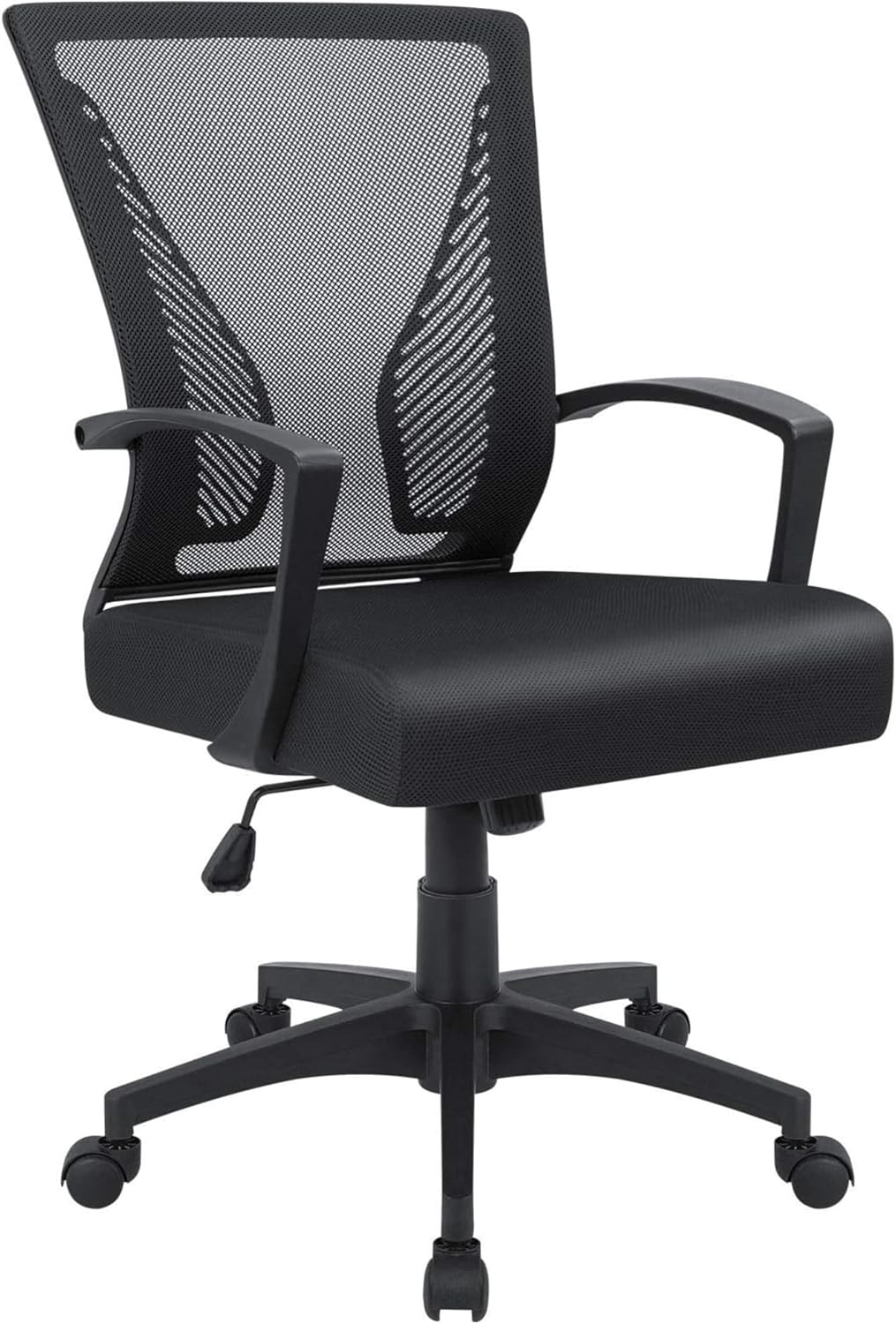
Pros
- 19.7 x 19.7 in footprint
- Arms plus reclining backrest
- Seat height 16.5 to 20.5 in
Cons
- Fixed arms need desk clearance
- Long 19.7 in seat for shorter users
Frequently Asked Questions
Can you steam clean an office chair?
Not unless your chair’s care sheet specifically allows it. HON says heat should never be used when cleaning textiles because it can set stains permanently, and Herman Miller says never to use hot water on the Aeron’s fabric. Steam also puts a lot of moisture into padding, which several makers warn against.
Can I use disinfecting wipes on my office chair?
On hard parts such as the frame, arms and base, many makers allow specific disinfectants, and Steelcase publishes a short list of the ones it approves. On fabric, mesh and leather, use a disinfectant only if the chair or fabric maker approves it for that material, and follow the product label, as the EPA advises.
How often should you clean an office chair?
There is no single schedule in the care sheets we reviewed. HON and Designtex recommend regular vacuuming or light brushing to keep dust from building up, and Steelcase notes that shared seating and high-touch surfaces need more frequent attention than a chair only one person uses. A practical habit is a quick vacuum and armrest wipe when you clean the rest of your desk, and a full clean whenever the chair looks or smells dirty.
How do I get a smell out of a fabric office chair?
Vacuum thoroughly, clean the fabric with the method its code allows, rinse away any cleaner residue and, most important, let the padding dry completely before use, since trapped moisture is hard to remove from foam. If an odor comes from a large spill that soaked into the cushion, HON and Herman Miller both recommend a professional upholstery cleaner for large or heavily soiled areas.
What if my office chair has no care label?
Look for a model number on a sticker under the seat and search the maker’s support site, or contact customer service. HON, for example, prints the fabric code inside the model number on its serial sticker. Until you know the material, limit yourself to vacuuming, light brushing and blotting spills with a dry cloth.
Conclusion
Cleaning an office chair well is mostly about restraint. Find the cleaning code or care sheet, vacuum first, try your cleaner somewhere hidden, then use the gentlest method the material allows: mild soap and warm water for most mesh, the W, S, WS or X method for fabric, whole-panel wiping and no heat for leather, and mild detergent for the frame and base. Use little liquid, blot rather than scrub, rinse off residue and let the chair dry completely. When a stain or a large spill goes beyond that, the chair makers’ own advice is the same: call a professional cleaner.
Sources
- Herman Miller, Aeron Chair Care and Maintenance (PDF)
- HON, Product Care Guide (PDF)
- HON, Seating Care and Maintenance (PDF)
- HON, Material Cleaning Guidelines (PDF)
- HBF Textiles, Cleaning Codes (PDF)
- Designtex, Cleaning Manual (PDF)
- Steelcase, Cleaning Your Steelcase Products
- US Environmental Protection Agency, What’s the difference between products that disinfect, sanitize, and clean surfaces?
- iFixit, Rolling Office Chair Wheel Disassembly (community repair guide)
About the author

HomeOfficeAid writes reviews and buying guides for HomeOfficeAid.