
How to Fix a Sinking Office Chair in 5 Steps
A sinking seat almost always means a worn gas cylinder. Check the warranty first, make sure the lever is not stuck, then fit a cylinder made for your chair.
 By HomeOfficeAid
Updated November 25, 2026

How do you fix a sinking office chair? In most cases the seat drops because the gas cylinder, the pressurized column that holds the seat up, can no longer hold its position, and the lasting fix is to replace that cylinder with one made for your chair. Before you buy parts, check whether the chair is still under warranty, rule out a sticking height lever, and use a hose clamp or a pipe sleeve only as a short-term patch. This guide walks through each of those steps in order, from the quickest checks to a full cylinder swap.
This is a research-based guide, not a record of our own repairs. The replacement steps follow Herman Miller’s published cylinder replacement instructions and iFixit’s general gas cylinder guide, the warranty details come from Herman Miller and Steelcase, and the seat height advice comes from OSHA’s computer workstation eTool. If the chair turns out to be past saving, our guide to the best office chairs for long hours compares replacements by seat adjustment, lumbar support and listed weight capacity.
Why Office Chairs Sink
An adjustable office chair rests on a gas cylinder (also called a gas lift or pneumatic cylinder) that sits in the center of the five-star base and connects to the tilt mechanism under the seat. When you pull the height lever, it presses a small valve on top of the cylinder so the seat can move; when you let go, the valve closes and the seat should stay put. Herman Miller’s Embody instructions show this clearly: the height control there is a cable whose ball end clips onto the top of the cylinder.
That means a sinking seat usually comes from one of two places. Either the cylinder itself can no longer hold the seat once the valve is closed, which is the most common cause and is not something you can repair from the outside, or the lever or cable is keeping the valve pressed, so the seat behaves as if you were holding the lever. The first needs a new cylinder; the second may only need the lever freed or the cable reseated.
Quick Diagnosis: What Your Chair Is Telling You
| What you notice | Likely cause | What to do |
|---|---|---|
| Seat creeps down slowly while you sit, or drops a little each time you sit down | Worn gas cylinder | Check warranty, then replace the cylinder (steps 1 and 4) |
| Seat will not stay up at all, even right after you raise it | Failed cylinder, or the valve is being held open by the lever | Check the lever and cable first (step 2), then replace the cylinder |
| Height lever feels loose, stuck down or does nothing | Lever, cable or linkage problem | Free or reseat the lever or cable (step 2); contact the maker for parts |
| Seat wobbles, tilts to one side or separates from the base | Structural problem, not just the cylinder | Stop using the chair and check for recalls (step 1) |
| Seat height is fine but you still feel too low at your desk | Chair and desk height mismatch | Reset seat height and check desk height (step 5) |
How to Fix a Sinking Office Chair in 5 Steps
1. Check the warranty and recall status first
Cylinders are a covered part on many office chairs, so a quick look at the paperwork can save you the repair. Herman Miller says that, with limited exceptions, its products carry a 12-year warranty covering parts and labor. Steelcase’s limited lifetime warranty for the Americas, written for business buyers, lists pneumatic cylinders under a 12-year term, and says replacement parts are covered for 2 years or the balance of the original warranty, whichever is longer. Retail consumers buying Steelcase are pointed to a separate consumer warranty, so check the one that applies to your purchase.
Read the exclusions before you start taking anything apart. Steelcase’s warranty, for example, does not cover normal wear and tear or damage from alteration or modification of the product, which is a good reason to contact the maker before adding a clamp or swapping in a third-party cylinder. While you are at it, search the U.S. Consumer Product Safety Commission recall list for your chair’s brand and model. In 2012, Office Depot recalled about 307,000 Biella leather desk chairs in the United States because the weld connecting the seat plate to the gas lift could fail and let the chair separate from the base; the CPSC told owners to stop using them immediately. If your chair is on a recall list, follow the recall remedy instead of repairing it yourself.
2. Rule out the height lever and cable
Raise the seat, let go of the lever and watch it. It should spring back to its resting position on its own. If it stays partly pulled, something under the seat may be pressing it, such as a bent lever, a loose bracket, or debris in the linkage. On chairs where the lever works through a cable, like the Herman Miller Embody, the cable end clips onto the top of the cylinder; Herman Miller’s instructions free it by prying up a cable collar with a flat screwdriver and pushing the cable forward to release the ball end. A cable that has slipped or is pulled tight can keep the valve open.
If the lever returns properly and the seat still sinks, the cylinder is the problem. Lever and cable parts are specific to each chair, so ask the manufacturer for the right part rather than forcing the mechanism.
3. Use a temporary fix only if you need the chair today
Two common stopgaps hold the seat at one height by blocking the exposed shaft of the cylinder from sliding down. Raise the seat to the height you want, slide up the plastic skirt that covers the cylinder, and either tighten a metal hose clamp around the exposed shaft just below the cylinder’s outer housing, or snap a length of PVC pipe, slit along one side, around the shaft. Some people wrap the shaft with tape first so a clamp grips without slipping.
Treat these as a way to get through the week, not a repair. They lock the chair at one height, so it can no longer be adjusted for other people or for a different desk, and they count as a modification under some warranties, as noted above. They also do nothing about a cylinder that is failing in other ways. Do not drill, cut or heat the cylinder itself; it is a sealed, pressurized part.
4. Replace the gas cylinder
Start by finding a compatible cylinder. iFixit’s guide recommends looking up the chair’s part number to see which cylinders fit, and many brand-name chairs use cylinders made for that model, such as the cable-operated cylinder in the Embody. The chair’s manual, the label under the seat, or the manufacturer’s parts service are the most reliable places to look. Then follow the instructions that come with your specific cylinder, since iFixit notes that installation can vary from one cylinder to another.
Herman Miller’s Embody instructions outline the general sequence used on many chairs:
- Raise the seat to its highest position and lay the chair down. Herman Miller lays the Embody on its back; iFixit puts the chair on its side.
- Disconnect anything attached to the top of the cylinder, such as a height cable.
- Free the base: Herman Miller places a nylon cap over the bottom of the cylinder and strikes the cap with a 2-pound hammer until the base comes loose. iFixit notes that some bases are held with retaining clips or nuts and bolts instead.
- Remove the old cylinder from the seat mechanism. Herman Miller straps a lift-off tool to the top of the cylinder and strikes it with a hammer until the cylinder separates from the tilt housing; iFixit uses a pipe wrench and a spray lubricant to twist it free.
- Push the new cylinder into the seat mechanism, slide the base onto it, and reconnect any cable.
- Stand the chair up and sit down firmly several times to set the cylinder, as Herman Miller’s instructions say.
The tools Herman Miller lists for the Embody are a flat screwdriver, a hammer, a nylon cap and a lift-off tool. Wear eye protection when striking metal parts, keep your hands clear of the base while you work, and ask your local recycling center how to dispose of the old cylinder. If the cylinder will not come out, stop and contact the chair maker or a furniture repair shop instead of applying more force.
5. Reset your seat height and check your desk
Once the chair holds its height again, set it to fit you. OSHA’s computer workstation eTool says the chair height is appropriate when the entire sole of the foot can rest on the floor with the back of the knee slightly higher than the seat of the chair, and that seat height should be adjustable, especially when a chair is shared by several people. Our step-by-step guide on how to adjust an office chair covers seat depth, armrests and lumbar support after the height is set.
If you now sit at a comfortable height but the desk feels too high or too low, the chair was never the whole problem. Our guide to standing desk height explains how to match desk height to your elbows, and the article on what size desk you need covers legroom under the desk, which matters once your seat is back at its proper height.
Repair or Replace the Chair?
A new cylinder is usually worth fitting when the rest of the chair is sound: the base has no cracks, the seat does not wobble, the backrest and armrests still adjust, and the upholstery is in reasonable shape. It is also the obvious choice when the cylinder is covered by warranty. OSHA notes that a chair should have a strong, five-legged base, and that chairs with four or fewer legs may provide inadequate support and are prone to tipping, so a damaged or missing base leg is a reason to replace the base or the chair rather than just the cylinder.
Replacing the chair makes more sense when several parts are failing at once, when the base or seat plate shows cracks or bent metal, when no compatible cylinder is available, or when the chair never fit you well. If you are short on space, our list of the best small office chairs focuses on compact and armless models, and our guide on how to set up a home office shows where a new chair fits into the rest of the workstation.
If You Decide to Replace the Chair
If the base is cracked, no compatible cylinder is available, or several adjustments are failing at once, a new chair may be the better use of your time. These three come from our guide to the best office chairs for long hours and cover different needs: a mid-back mesh chair with adjustable arms and a long listed warranty, a mesh chair with an adjustable headrest for taller users, and a big and tall chair with a higher listed weight capacity. Check the seat height range and weight rating on each listing against your own measurements before you buy.

Pros
- Arms adjust for height and width
- Adjustable lumbar, tilt mechanism
- Lifetime warranty per listing
Cons
- Listing gives one seat height, no range
- No headrest; casters listed for hard floors
Pros
- Adjustable headrest and lumbar
- Listed for users about 5'6" to 6'2"
- 330 lb capacity, tilt lock
Cons
- Not sized for petite users
- Listing has conflicting model and size data
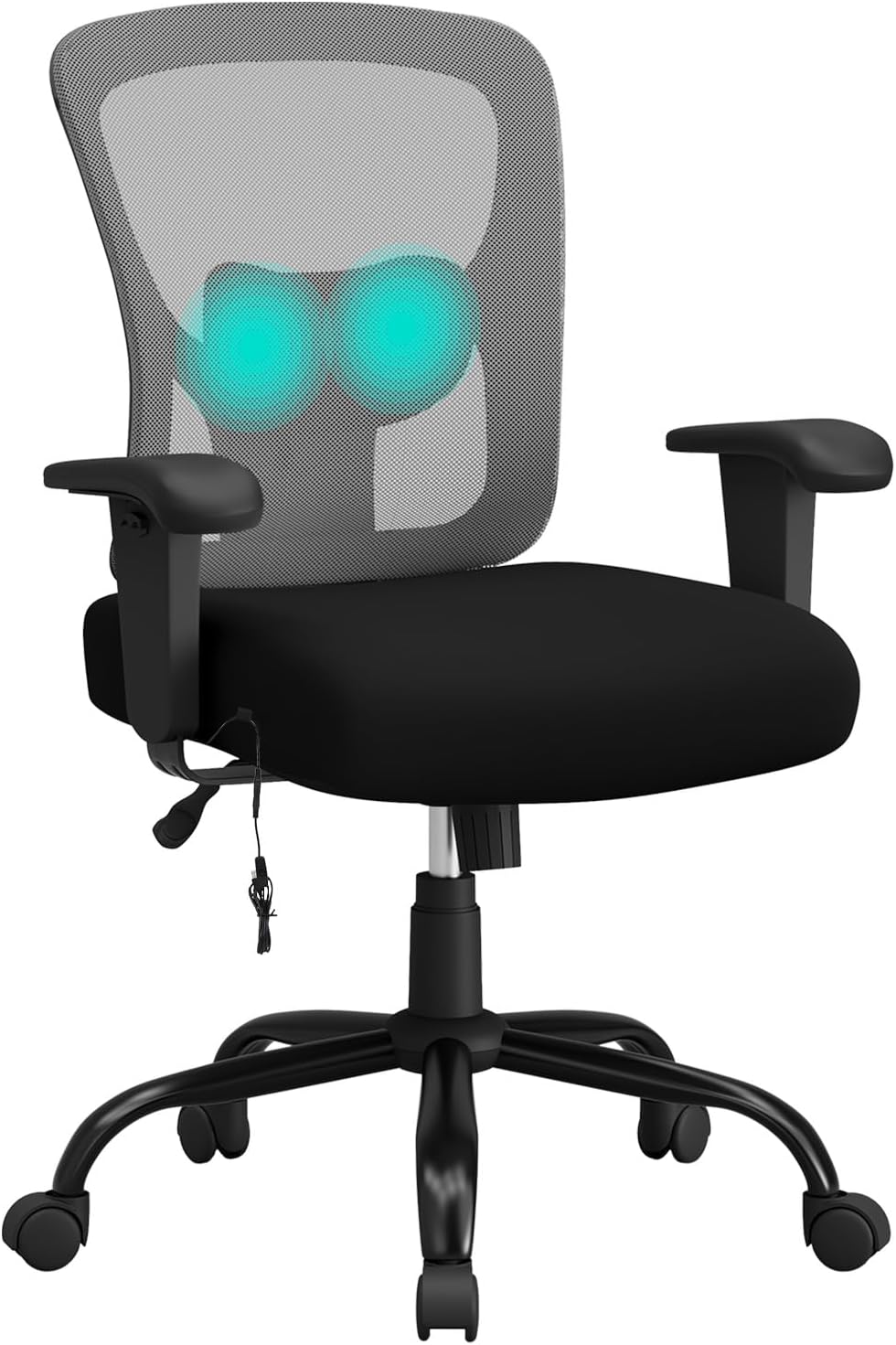
Pros
- Listed for up to 400 lb
- Thick, wide cushioned seat
- Heavy-duty metal base
Cons
- Arms adjust for height only
- Seat specs in listing are inconsistent
Frequently Asked Questions
Why does my office chair keep sinking?
Usually because the gas cylinder can no longer hold the seat once the height valve is closed. Less often, the height lever or cable is stuck and keeps the valve open. If the lever springs back normally and the seat still drops, plan on replacing the cylinder.
Can you fix a sinking office chair without replacing the cylinder?
Only temporarily. A hose clamp or a slit piece of PVC pipe around the cylinder shaft can hold the seat at one height, but the chair can no longer be adjusted, and some warranties do not cover modified chairs. A new cylinder is the lasting fix.
Is a sinking office chair covered by warranty?
It often is on brand-name chairs. Herman Miller says most of its products have a 12-year warranty covering parts and labor, with limited exceptions, and Steelcase’s warranty for the Americas lists pneumatic cylinders under a 12-year term. Check the warranty for your specific model and where you bought it.
How do I know which gas cylinder fits my chair?
Start with the chair’s part number or model name, which is often on a label under the seat or in the manual, and check it against the manufacturer’s parts list. iFixit recommends looking up the part number to find compatible cylinders. Brand-name chairs may need a cylinder made for that model.
Is it safe to keep using a chair that sinks?
A seat that slowly lowers is mainly an ergonomic problem, because you end up sitting too low for your desk. A chair whose seat wobbles, tilts or separates from the base is a different matter: stop using it and check for recalls, as owners of the chairs in Office Depot’s 2012 recall were told to do.
Conclusion
A sinking office chair is almost always a cylinder problem, and the fix runs in a simple order: check the warranty and recall lists, make sure the lever and cable are not holding the valve open, use a clamp or pipe sleeve only to get by, then fit a cylinder made for your chair and sit firmly to set it. Finish by resetting the seat height so your feet rest flat on the floor. If the base, seat plate or other adjustments are also failing, put the effort into a replacement chair instead.
Sources
- Herman Miller, Embody Cylinder Replacement instructions (1B4YHP Rev A)
- Herman Miller, Warranty and Service
- Steelcase, Steelcase Limited Lifetime Warranty for Americas (updated October 21, 2024)
- iFixit, Office Chair Gas Cylinder Replacement
- OSHA, Computer Workstations eTool: Chairs
- U.S. Consumer Product Safety Commission, Office Depot Recalls Desk Chairs Due to Fall Hazard (recall 12-146, April 5, 2012), cpsc.gov/Recalls
About the author

HomeOfficeAid writes reviews and buying guides for HomeOfficeAid.