
6 Best Mechanical Pencils for Writing, Drafting and Notes
Six mechanical pencils matched to different needs, from a classic 0.5 mm everyday pencil to a self-rotating lead, a retractable tip, a drafting pencil and a break-resistant lead.
 By HomeOfficeAid
Updated November 22, 2026
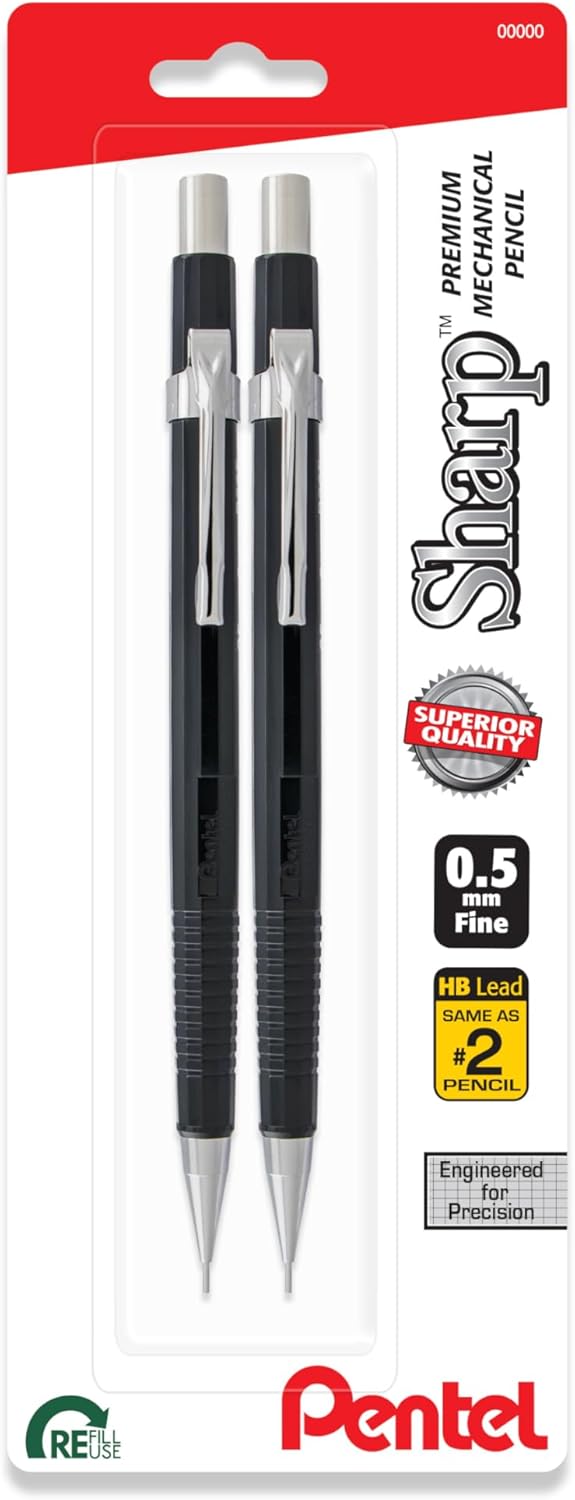
The best mechanical pencil for most people is a simple 0.5 mm pencil with a long metal tip and a refillable lead, such as the Pentel Sharp P205. Pick something more specialized only if you have a specific problem: a lead that wears into a flat, uneven point, a tip that pokes holes in your bag, ruler work that needs a heavy metal barrel, a lead that keeps snapping, or an eraser that runs out too soon. This research-based guide compares six mechanical pencils by need, using the specs and descriptions in each Amazon listing and the makers’ own explanations where we could read them.
Here is the short version by need:
- Best everyday mechanical pencil: the Pentel Sharp P205 in 0.5 mm, a classic refillable pencil with a 4 mm tip for rulers.
- Best for even lines in notes: the uni Kuru Toga Advance, which turns the lead as you write so the point wears evenly.
- Best for carrying in a bag or pocket: the Pentel GraphGear 1000, whose tip retracts into the barrel.
- Best for technical drawing: the rOtring 600, a metal, hexagonal drafting pencil with a fixed lead sleeve.
- Best for heavy-handed writers: the Zebra DelGuard, built around a system meant to stop the lead from breaking.
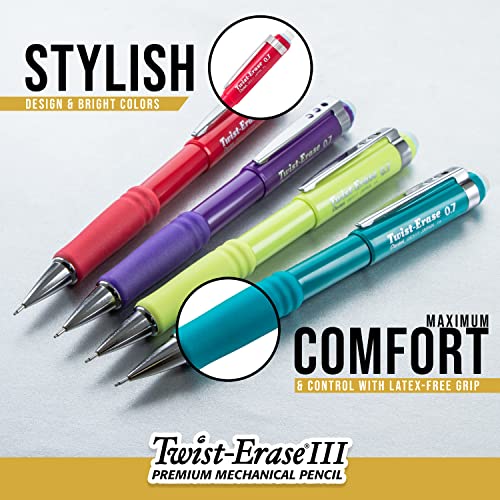
- Best for students who erase a lot: the Pentel Twist-Erase III in 0.7 mm, with a larger twist-up eraser.
If you also write in ink, our guide to the best gel pens covers pens matched to the same kinds of needs, and our small study room ideas show how to set up a desk you can work at for long sessions.
How We Chose
This is a research-based guide. We have not written or drawn with these pencils ourselves, and we did not measure lead breakage, line darkness or eraser life. We started from the problems people describe when they shop for a mechanical pencil: an all-round pencil for daily notes, lines that get thicker as the lead wears, tips that break in a pencil case, ruler and template work, leads that snap under pressure, and erasers that wear down quickly. Then we picked one pencil for each problem, so no two picks do the same job.
For each pencil we read the Amazon listing, and for the Kuru Toga we also read uniball’s own description of its lead rotation system. Several makers’ websites blocked our requests, so for those pencils the feature claims come from the listings, and we report them as the maker’s claims. We only included pencils that were in stock and had a large number of customer ratings when we checked. We reviewed nine candidate listings and six qualified. Specs can change, so check the current listing before you buy. Where a listing contradicts itself, we say so.
Our Top Picks: Best Mechanical Pencils by Need
Pros
- 4 mm tip for rulers and templates
- Pre-loaded HB lead, refillable
- Also in 0.7 mm and 0.9 mm
Cons
- Fixed tip can poke through a bag
- Simple, uncushioned grip

Pros
- Lead turns every 20 strokes per listing
- Sliding sleeve, write without clicking
- Nano Dia lead included
Cons
- Needs lifts between strokes
- Resin body, smooth grip

Pros
- Tip retracts to protect the lead
- Lead hardness indicator
- Metal grip with latex-free pads
Cons
- Single pencil, not a pack
- Heavier than plastic pencils

Pros
- Full metal hexagonal barrel
- Brass lead mechanism
- Fixed sleeve for ruler work
Cons
- Sleeve does not retract
- Knurled grip can feel rough

Pros
- Spring and guard protect the lead
- Built for heavy pressure
- Knurled grip
Cons
- Advance lead a little at a time
- Listing details are unclear
Pros
- Large twist-up eraser
- Oversized latex-free grip
- Tip design to reduce breakage
Cons
- Barrel color is assorted
- 0.7 mm too bold for tiny notes
Best everyday mechanical pencil: Pentel Sharp P205
The Pentel Sharp is a plain, light pencil that does the everyday jobs well: class notes, crosswords, forms, sketching layouts and quick math. It has a 4 mm metal tip, which the listing says makes it suited to rulers and templates, and it comes loaded with Pentel’s Super Hi-Polymer HB lead. The same pencil is sold in 0.5 mm, 0.7 mm and 0.9 mm, so you can stay with the design if you later want a thicker lead. This pick is the 0.5 mm two-pack with black barrels.
Key specs (per the Amazon listing):
- 0.5 mm lead; 2 pencils, black barrels; model P205BP2.
- 4 mm tip length for use with rulers and templates.
- Pre-loaded with Pentel Super Hi-Polymer HB lead; refillable.
- Also sold in 0.7 mm and 0.9 mm.
- Limited Lifetime Warranty (USA only), per the listing.
Consider: The tip does not retract, so a 4 mm metal sleeve can bend or poke through fabric if you toss the pencil loose into a bag; use a pencil case or choose the GraphGear 1000 below. The grip is a simple textured section, not a cushioned one, so if you write for hours and grip hard, the Twist-Erase III has a larger, softer grip. The spec table lists “Material Type: Lead” and “Ink Base: Water,” which are filler values that tell you nothing about the pencil.
Best for even lines in notes: uni Kuru Toga Advance
On an ordinary mechanical pencil, the lead wears down on one side and forms a slanted, wedge-shaped tip, so your line gets thicker or thinner depending on how you hold the pencil. Uniball says its Kuru Toga system fixes this: every time you lift the pencil from the paper, a spring-loaded clutch rotates the lead slightly so it wears down evenly. The listing says the Advance version turns the lead once every 20 strokes, compared with once every 40 strokes on standard Kuru Toga pencils. It also has a lead sleeve that slides back into the pencil as the lead gets shorter, so you can keep writing for a while without clicking.
Key specs (per the Amazon listing):
- 0.5 mm lead; black barrel; model M5-5591P.24.
- Lead rotates once every 20 strokes (W-Speed engine), per the listing.
- Sliding lead sleeve that retracts as the lead wears; can be fully retracted when not in use.
- Comes with Nano Dia lead, which the listing describes as infused with nanodiamond particles.
- Resin body; listed as ambidextrous.
Consider: The rotation needs you to lift the pencil between strokes, so it helps most with handwriting and note-taking and less with long, continuous shading. The barrel is resin, not metal, and the spec table lists a smooth grip, so this is not the pencil for people who want a knurled or cushioned grip. The table also lists the closure type as “Twist,” while the feature text describes a standard click-to-advance pencil with a sliding sleeve; go by the description.
Best for carrying in a bag or pocket: Pentel GraphGear 1000
The GraphGear 1000 has the same 4 mm tip length as the Pentel Sharp, but a dual-action retractor pulls the tip back into the barrel when you are done, which the listing says protects the lead from breaking. That makes it the pick if your pencil lives in a backpack, laptop bag or shirt pocket. It also has a built-in lead hardness indicator, a metal grip with soft latex-free pads, and a cap that keeps the eraser clean. The listing says it ships with three Super Hi-Polymer HB refill leads.
Key specs (per the Amazon listing):
- 0.5 mm lead; black barrel; 1 pencil; model PG1015-A.
- Dual-action retractable tip; 4 mm tip length.
- Metal grip with latex-free pads; lead hardness indicator; pocket clip.
- Pre-loaded HB lead plus 3 refill leads; eraser under a cap.
- Also sold in 0.3 mm, 0.7 mm and 0.9 mm, color coded by size.
- Limited Lifetime Warranty (USA only), per the listing.
Consider: This is one pencil, not a pack, so it costs more per pencil than the Pentel Sharp two-pack. A metal grip makes it heavier than a plastic pencil, which some people like for control and others find tiring. The spec table lists a “Hand Orientation” of left and an “Ink Base” of oil, neither of which means anything for a pencil, and “Item Diameter: 0.5 millimeters” is the lead size, not the barrel width.
Best for technical drawing: rOtring 600
The rOtring 600 is a drafting pencil for ruler and template work. The listing describes a full metal body, a non-slip knurled metal grip and a hexagonal barrel that keeps the pencil from rolling off a sloped or crowded desk. A brass mechanism advances the lead, and a fixed lead guidance sleeve is meant to prevent breakage and leave a clear view of the page next to a ruler. It has a lead grade indicator and a small eraser under the push-button cap. The listing gives the weight as 22.68 g.
Key specs (per the Amazon listing):
- 0.5 mm lead; black metal barrel; model 1904443.
- Full metal body, knurled metal grip, hexagonal barrel.
- Brass lead mechanism; fixed lead guidance sleeve.
- Lead grade indicator; eraser under the push-button cap; refillable with standard 0.5 mm lead.
- 2 year warranty, per the listing.
Consider: The lead sleeve is fixed, so it does not retract; carry the pencil in a case to protect the tip and your pockets. A knurled metal grip gives a firm hold, but some people find it rough during long writing sessions. The listing contradicts itself in two places: the spec table gives the closure as “Retractable” even though the feature text describes a fixed sleeve, and it lists a lead hardness of B while the title does not say which lead is included. Check what lead comes in the pencil, and buy your preferred grade if it matters.
Best for heavy-handed writers: Zebra DelGuard
If you press hard and snap leads often, the DelGuard is built for you. The listing describes two mechanisms that work together: a spring inside the barrel absorbs strong downward pressure, and when you press hard at an angle, a metal guard comes out at the tip to wrap and support the lead. The listing says the pencil adjusts between the two automatically based on the angle and strength of your pressure. It has a 0.5 mm lead and a knurled grip.
Key specs (per the Amazon listing):
- 0.5 mm lead; black body; model P-MA85-BK.
- DelGuard lead break protection: internal spring plus a metal guard at the tip.
- Knurled grip; listing weight 27.22 g.
- Spec table lists lead hardness B.
Consider: The listing’s own note says the protection depends on having lead out of the tip, and that the lead may break if you start writing after clicking more than four times from a retracted state, so advance the lead a little at a time. The translated description is hard to follow, and the listing does not say whether an eraser or refill leads are included, so check the photos. The spec table gives “Hand Orientation: Right” and “Item Diameter: 1 centimeters,” which look like listing errors rather than real limits. A spring that gives under pressure can feel soft if you are used to a rigid pencil.
Best for students who erase a lot: Pentel Twist-Erase III 0.7 mm
The small eraser on most mechanical pencils runs out fast, and once it is gone you end up hunting for a separate eraser. The Twist-Erase III has what the listing calls a larger-than-ordinary twist-up eraser that you extend as it wears, and Pentel claims it erases with no smudges, paper tears or “ghosts.” It also has an oversized latex-free grip and a protective tip design that the listing says stabilizes the lead to reduce breakage. The 0.7 mm lead gives a bolder line than 0.5 mm, which suits math homework, worksheets and rough drafts.
Key specs (per the Amazon listing):
- 0.7 mm lead; 1 pencil in an assorted fashion color; model QE517FBPM.
- Larger twist-up eraser.
- Oversized latex-free grip.
- Protective tip design to reduce lead breakage, per the listing.
Consider: This listing sells one pencil in an assorted color, so you may not be able to choose the barrel color. The listing gives fewer details than the others: it does not state the included lead grade or whether eraser refills come in the box, and its spec table lists the “Ink Color” as multicolor, which refers to the barrel, not the lead. A 0.7 mm line is too thick for very small handwriting or fine diagrams; the Kuru Toga or Pentel Sharp in 0.5 mm suits those better.
Comparison Table
| Pencil | Lead size | Tip | Body | Key feature (per listing) | Best for |
|---|---|---|---|---|---|
| Pentel Sharp P205 | 0.5 mm (also 0.7, 0.9) | 4 mm, fixed | Plastic | Classic design, refillable | Everyday writing |
| uni Kuru Toga Advance | 0.5 mm | Sliding sleeve | Resin | Lead turns every 20 strokes | Even lines in notes |
| Pentel GraphGear 1000 | 0.5 mm (also 0.3, 0.7, 0.9) | 4 mm, retractable | Metal grip | Tip retracts into barrel | Carrying in a bag |
| rOtring 600 | 0.5 mm | Fixed sleeve | Full metal, hexagonal | Brass mechanism, no-roll barrel | Technical drawing |
| Zebra DelGuard | 0.5 mm | Guard extends under pressure | Knurled grip | Spring plus guard against breakage | Heavy-handed writers |
| Pentel Twist-Erase III | 0.7 mm | Protective tip | Plastic, oversized grip | Large twist-up eraser | Students who erase a lot |
How to Choose a Mechanical Pencil
Pick a lead size for your writing
Lead size is the width of the lead in millimeters, and it sets the width of your line. Thin leads such as 0.3 mm suit very small handwriting and fine detail but are more fragile. 0.5 mm is the common middle choice for notes and general writing. 0.7 mm gives a bolder line and is a good fit for people who press hard. 0.9 mm is bold enough for sketching and rough layout. Buy refill lead in the same size as your pencil, since leads are not interchangeable between sizes.
Choose a lead grade
Lead grade describes how hard the lead is. HB sits in the middle and is what most of these pencils come with. B grades are softer and darker but smudge more and wear faster; H grades are harder and lighter. If your notes look faint, try a B lead; if they smear on the side of your hand, try HB or harder. Several picks have a lead hardness indicator so you can mark which grade is loaded.
Decide between a fixed and a retractable tip
A long fixed tip, like the 4 mm sleeve on the Pentel Sharp or the rOtring 600, gives a clear view along a ruler but can bend or poke through fabric in a bag. A retractable tip, like the GraphGear 1000, protects itself when not in use. If your pencil travels, retractable is less hassle.
Look at the grip and weight
Metal pencils such as the rOtring 600 and GraphGear 1000 feel heavier and more stable; plastic pencils such as the Pentel Sharp are lighter. Knurled metal gives a firm hold but can feel rough. A larger, softer grip like the Twist-Erase III can be easier to hold for long homework sessions. Pairing any pencil with a good desk lamp also helps, since light HB lines are easier to read under good light.
Check the eraser and refills
Most mechanical pencils have a small eraser under the cap that is meant for quick fixes. If you erase a lot, choose a pencil with a larger twist-up eraser or keep a separate eraser on the desk. All six picks are refillable with standard lead in their size.
For study sessions, the Pomodoro Technique guide shows how to break work into focused blocks, which pairs well with a pencil you can pick up and put down quickly.
Frequently Asked Questions
What is the best mechanical pencil for everyday writing?
For most people, a simple 0.5 mm refillable pencil such as the Pentel Sharp P205 is a sensible default. If your lines get uneven as the lead wears, the uni Kuru Toga Advance rotates the lead to keep the point even.
Is 0.5 mm or 0.7 mm better?
0.5 mm gives a thinner line that suits small handwriting and detailed notes. 0.7 mm gives a bolder line and is a common choice for people who press hard or who want a darker line without switching to a softer lead.
Can you use a mechanical pencil on the ACT?
No. ACT’s test day checklist tells students to bring sharpened No. 2 pencils with erasers, and says no pens or mechanical pencils. Keep a mechanical pencil for practice and homework, and bring wooden No. 2 pencils on test day. Check ACT’s current checklist before your test, since rules can change.
Why does my mechanical pencil lead keep breaking?
Common causes are pressing hard, advancing too much lead at once, and using a thin lead. Try advancing less lead, switching to 0.7 mm, or choosing a pencil designed to protect the lead, such as the Zebra DelGuard.
What does a self-sharpening mechanical pencil do?
A self-sharpening pencil, such as the Kuru Toga, rotates the lead a little each time you lift it from the paper, so the lead wears evenly instead of forming a flat, slanted edge. Uniball describes this as producing smooth, consistent lines.
Conclusion
For most desks, start with the 0.5 mm Pentel Sharp P205, then match a second pencil to the problem you actually have. Choose the uni Kuru Toga Advance for even lines in notes, the Pentel GraphGear 1000 if your pencil travels, the rOtring 600 for ruler and template work, the Zebra DelGuard if you keep snapping leads, and the Pentel Twist-Erase III if you erase a lot. Check the current listing before buying, since pack contents and specs can change.
Sources
- uniball, Technologies: Self-sharpening Lead Mechanism (Kuru Toga). unibrands.co/pages/technologies
- ACT, Test Day Checklist: What to Bring and What to Expect. act.org/…/the-act/test-day.html
- Amazon product listings for each pencil (specs and maker descriptions as listed, checked November 22, 2026), linked in each product section.
About the author

HomeOfficeAid writes reviews and buying guides for HomeOfficeAid.