
3 Best Office Chairs for Long Hours of Sitting
Three office chairs for long workdays matched to different needs: an adjustable task chair, a headrest pick for taller users and a 400 lb option.
 By HomeOfficeAid
Updated November 16, 2026

This article is general information, not medical advice. If you have back, neck or leg pain, talk to a qualified health professional.
The best office chair for long hours is one that fits your body and that you can adjust without standing up: a seat height that lets your feet rest flat, a seat depth that supports your thighs without pressing behind your knees, a backrest with lumbar support you can position, armrests that let your shoulders relax, a recline you can lock or tension, and a stable five-leg base. No single chair fits everyone, so the right pick depends mostly on your height, your weight and the adjustments you will actually use.
Here is the short version by need:
- Everyday task work with adjustable arms: the HON Ignition 2.0 mid-back mesh chair.
- Taller users who want a headrest: the SIHOO M18, which its listing sizes for people about 5’6″ to 6’2″.
- A higher weight capacity: the BestOffice Big and Tall chair, listed for up to 400 lb.
Whatever you buy, the settings matter as much as the model. Our guide on how to adjust an office chair walks through each one, and how to set up a home office covers the desk, keyboard and screen around it.
How We Chose
This is a research-based guide. We did not sit in or try these chairs ourselves. We started from public ergonomics guidance, mainly the OSHA Computer Workstations eTool and the Canadian Centre for Occupational Health and Safety (CCOHS), which describe what a work chair should offer: adjustable seat height, seat depth that suits short and tall users, a backrest with lumbar support, armrests that can be adjusted or removed, a recline that locks or has tension control, and a five-point base. We then compared each chair’s listed adjustments, seat dimensions, weight capacity and warranty against that checklist.
We only included chairs that were in stock and had a large number of customer ratings when we checked. We reviewed ten candidate listings for this guide. Several well-known models, including chairs we expected to feature, did not meet that bar at the time, or their listing data could not be confirmed, so this list has three picks instead of a padded roundup. Specs come from the Amazon listings and can change; where a listing contradicts itself, we say so. Confirm the details on the product page before you buy.
Our Top Picks: Best Office Chairs for Long Hours by Need
Pros
- Arms adjust for height and width
- Adjustable lumbar, tilt mechanism
- Lifetime warranty per listing
Cons
- Listing gives one seat height, no range
- No headrest; casters listed for hard floors

Pros
- Adjustable headrest and lumbar
- Listed for users about 5'6" to 6'2"
- 330 lb capacity, tilt lock
Cons
- Not sized for petite users
- Listing has conflicting model and size data
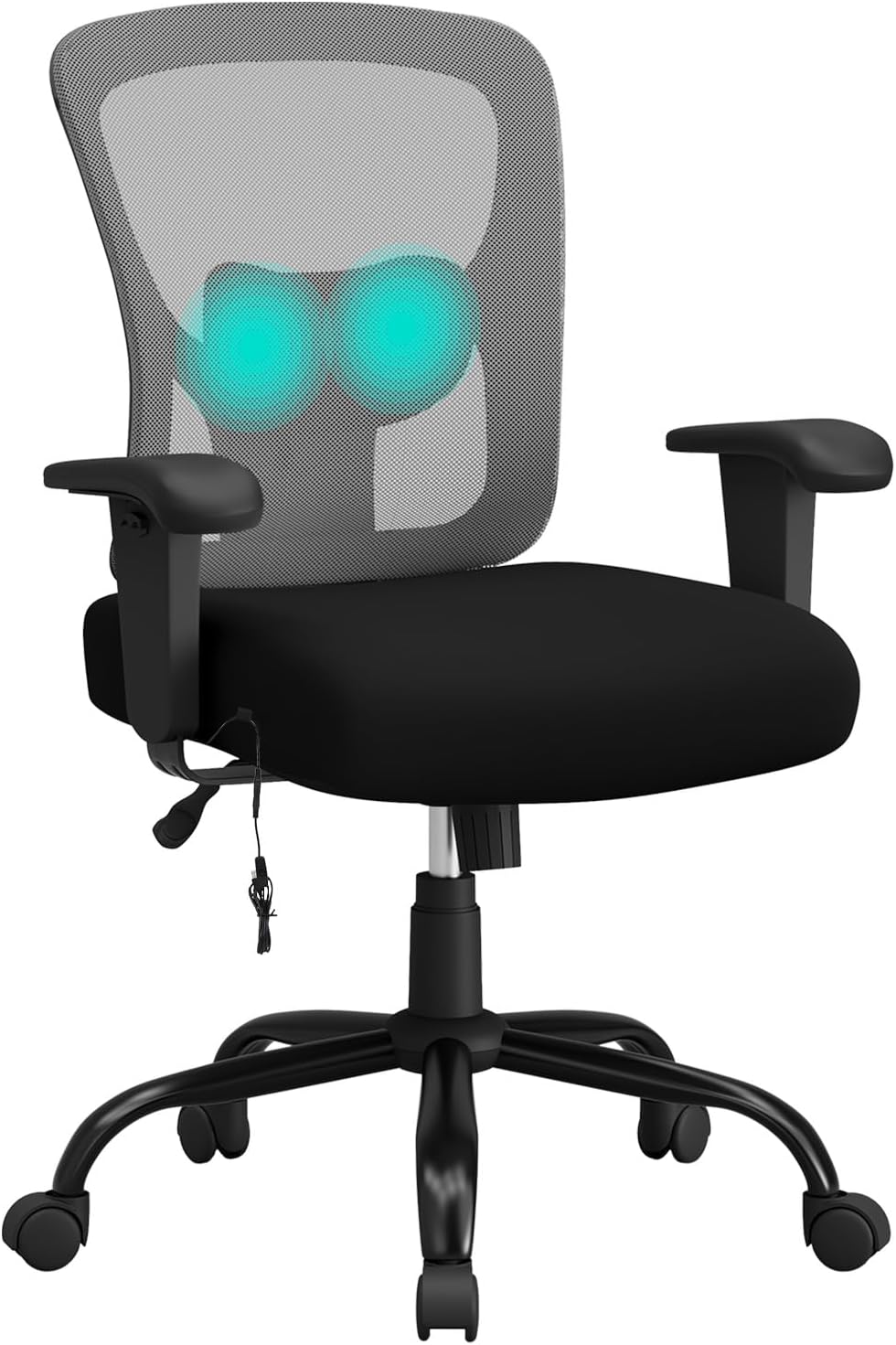
Pros
- Listed for up to 400 lb
- Thick, wide cushioned seat
- Heavy-duty metal base
Cons
- Arms adjust for height only
- Seat specs in listing are inconsistent
Best for everyday task work: HON Ignition 2.0 Mid-Back Mesh Chair
The Ignition 2.0 is a mid-back mesh task chair from an office furniture maker, built around the adjustments OSHA lists for a work chair: lumbar support, armrests that move up and down and in and out, and a tilt mechanism. The mesh back is meant to let air move, which CCOHS also mentions as a seat and back material consideration.
Key specs (per the Amazon listing):
- Mid-back mesh backrest; fabric seat with foam fill and a knife-edge cushion.
- Lumbar support listed as adjustable; arms adjust for height and width.
- Seat depth 19 in; seat width (listed as seat length) 20 in; backrest width 19 in.
- Maximum weight recommendation 300 lb.
- Overall 28.5 x 27 x 43.75 in (D x W x H); item weight 24 lb; five-star metal base with casters listed for hard floors.
- HON full lifetime warranty, per the listing.
Consider: The listing gives a single seat height of 17.25 inches rather than a range, and it does not say whether this configuration has a seat depth slider, so check the product page for the height range and seat options if you are shorter or taller than average. The casters are listed for hard floors; on carpet you may need a chair mat or different casters. There is no headrest on this version.
Best for taller users who want a headrest: SIHOO M18
The M18 adds an adjustable headrest to a mesh back with adjustable lumbar support and a tilt lock. Its listing sizes it for people about 5’6″ to 6’2″, so it is aimed at average to tall users rather than petite ones.
Key specs (per the Amazon listing):
- Mesh backrest with adjustable headrest and adjustable lumbar support.
- 2D armrests and a tilt lock, per the listing highlights; three recline positions.
- Seat depth 18 in; backrest width 20.47 in; memory foam seat.
- Maximum weight recommendation 330 lb; the listing also states a capacity of 150 kg and says the chair passed a BIFMA test.
- Item weight 14.3 kg (about 31.5 lb); 3-year warranty on replacement parts, per the listing.
Consider: The listing has several inconsistencies. Its model number field reads “M57″ although the title and model name say M18, its listed dimensions (27.5 x 11 x 21 in) look like a box or part size rather than the assembled chair, and it gives a single seat height of 20 inches instead of a range. If you are under about 5’6”, the listing’s own sizing suggests looking elsewhere. Seat depth is not listed as adjustable.
Best for a higher weight capacity: BestOffice Big and Tall Mesh Chair
OSHA notes that chairs with oversize seat pans should be provided for larger users. This BestOffice chair is listed for up to 400 lb with a wide, thick cushioned seat and a heavy-duty metal base, which makes it the option here for people who need more capacity than a standard task chair.
Key specs (per the Amazon listing):
- Maximum weight recommendation 400 lb.
- Mesh back with an adjustable-position lumbar support that includes a USB-powered massage unit.
- Padded armrests that adjust for height (listed as 6 positions).
- Overall 21.9 x 23 x 43.7 in (D x W x H); item weight 39 lb; metal base with nylon casters.
- High-density foam seat cushion.
Consider: This chair has fewer of the adjustments OSHA and CCOHS describe than the other two: the armrests adjust for height only, the listing shows one recline position, and seat depth is not adjustable. The spec table is also inconsistent: it lists a seat depth of 29 inches, which is more than the chair’s overall depth of 21.9 inches, and a backrest width of 11.5 inches, so check the product photos and page for real seat dimensions. If you plug the massage unit into a wall adapter, use one certified by a recognized lab such as UL or ETL and follow the manufacturer’s instructions. We make no claims about the massage feature.
Comparison Table
| Chair | Best for | Listed capacity | Seat depth (listed) | Lumbar | Armrests | Headrest |
|---|---|---|---|---|---|---|
| HON Ignition 2.0 | Everyday task work | 300 lb | 19 in | Adjustable | Height and width | No |
| SIHOO M18 | Taller users, headrest | 330 lb | 18 in | Adjustable | 2D | Yes, adjustable |
| BestOffice Big and Tall | Higher weight capacity | 400 lb | Listing inconsistent | Adjustable position, USB massage | Height only | No |
What Matters When You Sit All Day
Seat height you can set for your legs
OSHA describes the right chair height as one where the entire sole of your foot rests on the floor and the back of your knee sits slightly higher than the seat. CCOHS gives a rule of thumb that the optimal seat height is about one-quarter of your body height. Many listings give only one seat height figure, so look for the full range before you buy, and plan for a footrest if your desk is high.
Seat depth that matches your thighs
OSHA says the seat pan should be depth adjustable so it supports taller users while letting shorter users sit with their back fully supported. UCLA’s ergonomics program suggests leaving a 1 to 2 inch space between the front edge of the seat and the back of your knees. If a chair has no seat depth adjustment, compare its listed seat depth with the length of your thighs.
Lumbar support you can position
The backrest should follow the natural curve of your spine and give adequate lumbar support, and OSHA says that support should be height adjustable so it lands on your lower back. CCOHS recommends a backrest that adjusts both up and down and forward and back, with a firm lumbar support.
Armrests that do not lift your shoulders
OSHA advises armrests that are low enough for relaxed shoulders, soft with rounded edges, and small enough that they do not stop you pulling the chair in. CCOHS says armrests should adjust for both height and width. Using armrests at all is optional, so a chair whose arms move out of the way can be just as useful.
A recline you can lock or tension
OSHA lists a recline of at least 15 degrees from vertical, with a backrest that locks in place or is tension adjustable so it resists your lower back’s movement. This matters over a long day because you can change position without the chair tipping you back.
A stable base, controls you can reach and the right size
Both OSHA and CCOHS recommend a five-leg base, and OSHA notes that chairs with four or fewer legs may tip. CCOHS adds that you should be able to operate the controls while seated and that casters should match your flooring. Check the listed weight capacity and seat width too: OSHA says seats should be wide enough for most hip sizes and that larger users should have oversize seat pans.
How to Choose an Office Chair for Long Hours
Start with your body, not the brand. Note your height and weight, measure the height of your desk and the length of your thighs, then use the checklist below.
- Capacity and sizing: pick a chair whose listed weight capacity and height range include you with room to spare. Listings like the SIHOO M18’s state a height range; if yours is outside it, move on.
- Seat height range: confirm the lowest and highest seat height. Shorter users with a standard desk may still need a footrest.
- Seat depth: an adjustable seat is the safest bet if more than one person will use the chair or if you are much shorter or taller than average.
- Lumbar and recline: look for lumbar support you can move and a recline that locks or has tension control.
- Armrests: height adjustment at minimum; width adjustment helps if you have narrow or broad shoulders.
- Return policy: CCOHS points out that one chair does not fit everyone and recommends trying a chair in a real work situation. Buying online, check the return window so you can do that at home.
A good chair still needs breaks. Our guide on how long to stand at a standing desk covers how ergonomics programs suggest alternating sitting, standing and moving, and our standing desk height guide helps you set the desk to match the chair.
Frequently Asked Questions
What makes an office chair good for long hours?
Adjustability that fits your body. OSHA and CCOHS both describe the same core features: adjustable seat height, a seat depth that suits your thighs, a backrest with positionable lumbar support, adjustable or removable armrests, a recline that locks or has tension, and a five-leg base.
How high should my office chair seat be?
High enough that your feet rest flat on the floor with the back of your knees slightly above the seat, per OSHA. CCOHS’s rule of thumb is about one-quarter of your body height. If the chair has to go higher to match your desk, add a footrest.
Is a mesh back better than a padded back for long hours?
CCOHS notes that seats are usually made of breathable materials that limit heat and moisture buildup, and mesh is one way to do that. Comfort is personal, though, and the adjustments above matter more than the material.
Do I need a headrest?
OSHA’s chair guidance focuses on the seat, backrest, lumbar support, armrests and base, and does not list a headrest. A headrest can be useful if you recline often, but it is a preference rather than a core requirement.
What if I am petite or very tall?
Check the listed seat height range, seat depth and any stated user height range before you buy. OSHA recommends chairs sized to fit small or large users. None of the three picks here is aimed at petite users, so shorter readers should look for a low minimum seat height and a short or adjustable seat depth.
Conclusion
For long days at a desk, choose the chair that fits your body and offers the adjustments you will use. Among the listings that met our bar, the HON Ignition 2.0 is the well-rounded task chair with height- and width-adjustable arms and a lifetime warranty, the SIHOO M18 suits average to tall users who want a headrest, and the BestOffice Big and Tall chair covers a higher weight capacity with fewer adjustments. Once it arrives, follow our chair adjustment steps and pair it with a properly set desk.
Sources
- OSHA, Computer Workstations eTool: Chairs. osha.gov/etools/computer-workstations/components/chairs
- Canadian Centre for Occupational Health and Safety (CCOHS), Office Ergonomics: Chairs. ccohs.ca/oshanswers/ergonomics/office/chair.html
- UCLA Ergonomics, Selecting a Chair. ergonomics.ucla.edu/office-ergonomics/selecting-a-chair
- Amazon product listings for the HON Ignition 2.0 (B06Y3PGPR2), SIHOO M18 (B07GNDDNMW) and BestOffice Big and Tall (B08HV7YHBS), checked November 16, 2026.
About the author

HomeOfficeAid writes reviews and buying guides for HomeOfficeAid.